Baptismal Solidarity
Baptismal Solidarity
Here’s a little Seminary inside lingo, 1st Isaiah and 2nd Isaiah. Before chapter 40, it’s clear that the original prophet Isaiah was writing about Jerusalem and the kingdom of Judah when it was still being ruled by the descendants of David. Starting at ch. 40, it’s equally clear that more than 100 years later, someone was inspired by God to update Isaiah for the Jewish people in their Babylonian exile.
While fearing the worst, 1st Isaiah still hoped that a good King would rule with personal righteousness and justice for all people, starting with the people of Judah. 2nd Isaiah understood that an exiled nation wouldn’t be able to act like a King. So in ch. 42, we read the first song about the “Suffering Servant,” whom Christians would interpret as a foreshadowing of Jesus. But before we jump to Jesus, we should be clear about who 2nd Isaiah identified as the Suffering Servant: not just one King but the Jewish people as a whole. And instead of a single King crushing “bruised reeds,” that is, their enemies, and snuffing out “dimly burning wicks,” that is, their lives, the entire Jewish people were to be “light to the nations, to open the eyes that are blind, to bring out the prisoners.”
Five centuries later, the Jewish people were effectively in exile under Roman occupation. And for many, the first step to ending that exile was to confess how they had failed to trust God’s promises for them and keep their covenant with God, by being baptized by John, neither of which Jesus needed to confess. But I don’t believe that Jesus was being baptized because he personally had to get right with God, but in a way to get right with us. Jesus’s baptism was an expression of his solidarity with us, even in our unrighteousness and injustice, our sin. And if Jesus is in solidarity with us even in our sin, then he is never out of solidarity with us, even unto death.
The Elusive One
The Elusive One
The Magi would likely have been astrologers, “wise men” of their time from the nation of Persia (modern day Iran) and Zoroastrians, a more recently developed monotheistic religion. As the Persian empire swallowed up the Babylonian empire several centuries earlier, the Zoroastrians came into contact with Judaism through the exile community. These magi would likely have known at least something of this ancient monotheistic people.
These astrologers, discerning patterns in the night sky that symbolized a great King coming out of Israel, naturally assumed that this royal baby had been born in the Capital city of Jerusalem. But the Jews alone understood that kings are not demigods, and that Israel's greatest once and future Davidic king would come from his birthplace, humble Bethlehem. But to know that, you had to know all the prophets, even the “minor” ones like Micah, quoted in today’s Gospel. The Wise Men discerned patterns in the stars that that got them a long way toward the King of the Jews; but to actually find him they still had go through the Jews.
As it was two millennia ago, so it is still that there is no salvation without the Jews and the covenant that the one God made with them so long ago. In that Covenant, God promised that they would be God’s people to bring all the nations of the world to them. Their required response, also quoting Micah, was to be faithful; to love justice, to do mercy, and to walk humbly with their God. And down to this day, that remains their promise and required response toward all the peoples.
Grace Lurking
Grace Lurking
There are ghosts lurking in our Bible readings this second Sunday after Christmas. I’m not sure this is a metaphor. The Gospel reading tells us part of the aftermath of the event we will celebrate this Tuesday, January 6th: The Epiphany (manifestation) of our Lord to the Magi, and by extension, to all the peoples of Earth. Having snuck out of Judea by a less traveled road, which would take King Herod longer to figure out, the Magi gave Joseph extra Mk time to intuit that the visit of such exotic Gentile travelers would attract unwanted attention.
But between the Holy Family’s flight into Egypt as asylees, and their return five years later, are the ghost verses 16-18: “Then Herod, seeing that he had been fooled by the wise men, was furious, and sent and killed in Bethlehem and its surrounding district all the male children who were two years old or less, according to the time he had been careful to ask the wise men. Then was fulfilled what had been spoken through the prophet Jeremiah: ‘A voice was heard in Ramah, lamenting and much weeping, Rachel weeping for her children, and she would not be comforted because they are no more.’”
The “Rachel” in this case is one of Jacob’s wives, and one of the mothers of the nation of Israel. The ghosts lurking here are what the Church calls The Holy Innocents, the “collateral damage” between God and those forces of accusation and hatred that we call satanic. The Church has long commemorated them on December 28th.
Who’s your Abba
Who’s your Abba
As we come to the end of the 1700th anniversary of the Council of Nicaea, and the Creed that bears its name, our readings this first Sunday after Christmas make clear that only because he is “of one being with the Father” can Jesus the only begotten of God make us children of God and heirs of eternal life, not slaves of God. The Nicene Creed is not a set of intellectual propositions about God. It is our adoption certificate.
“But to those who did accept him he gave power to become children of God, to those who believed in his name, who were born not from blood, or from the will of the flesh, or from human will but from God himself.” (Jo 1:12-13). This assertion becomes almost scandalously concrete in the First Letter of John, the same John, son of Zebedee and brother of our own James, to whom this Gospel is attributed. We are children of God, John says, “because God’s seed remains in [us],” in the original Greek, sperma. The Common English Bible uses a more modern term of which the ancients were unaware, but which makes the same point, “DNA.” A metaphor to be sure, but still a statement that our adoption by God through Jesus Christ is thicker than blood.
Hope is the Gift, Patience is the Cost
Hope is the Gift, Patience is the Cost
We are good Anglo-Catholic Episcopalians here at St. Monica and St, James. So, when our Bishop Diocesan speaks, we listen. On Monday, Bishop Budde emailed a meditation entitled, “The Cost and Gift of Hope at Christmas.” There’s a paradox: How does a gift have a cost? In her email, Mariann relayed the question that she is most often asked these days: Bishop, what gives you hope?
“To be people of hope is to risk disappointment;” she responded, “to be people of hope demands that we place ourselves in seemingly hopeless situations; to be people of hope is to courageously face an uncertain future.” That is certainly a cost of hope. And the gift? “The deepest, most lasting hope doesn’t depend on us alone; it comes as a gift to receive and to share…we celebrate Jesus’ birth every year, no matter what, as a reminder that God comes to us, and is with us, no matter what. With God, we needn’t pretend to be hopeful. At Christmas, God invites us to open our hearts to receive hope, and to practice hope, leaning on the sacred traditions that inspired our ancestors to keep the light of hope alive and pass it onto us.”
This night, we celebrate that the Creator of the Universe courageously placed themself in an uncertain future, so vulnerable and powerless that his situation might have seemed hopeless. And when God sent their divine messengers to announce the birth of the only King Chosen of God, they did not go to those whose wealth and power made hope unnecessary. They went to shepherds, who had to feed their sheep wherever they could find pasture. Not surprisingly, those who claimed some of that pasture as their exclusive property resented those who fed the sheep from their property, even though they might later buy some clothing made from those sheeps’ wool. Yet it was to shepherds, whose testimony was considered unreliable, who were the first to be given the greatest news ever, before or since, an everlasting King and Lord of peace, and good will toward all people of peace.
Legacy
Legacy
More than any other Gospel, Matthew’s, the most Jewish of the Gospels, refers to Jesus as “Son of David.” When we say that Jesus is the Christ, the Messiah, we are saying, first, that he is the Chosen King of Israel, the heir of Israel’s greatest king, David. And God had made a promise to him: “Your dynasty and your kingdom will be secured forever before me. Your throne will be established forever” (2 Samuel 7:16). David’s descendants did rule in Jerusalem for nearly four centuries. They didn’t always live up to their ancestor’s legacy. In today’s reading from Isaiah, his descendant Ahaz is pretty gutless. No, no, I don’t want to tempt God by asking for a sign, especially if that sign tells me I’m making a big mistake.
Finally, in 587 B.C., the last Davidic King in Jerusalem watched as his sons were executed by the Babylonians, and then was blinded and taken away in chains. About 70 years later, the Persians conquered the Babylonians, and their King allowed the exiles to go home to Jerusalem. But there was only one king in the Persian Empire. And so for another five centuries, David’s descendants lived with the legacy of God’s promise, and how they had failed to trust that promise. And no doubt, they clung to the hope of that promise, not just for themselves but for their people as well.
When the angel calls Joseph, “Son of David,” he isn’t telling him anything he doesn’t already know. He has known it from his earliest memories, as his parents taught him the glories of his legacy, and later of their failures. His betrothed, Mary, was to give him the next heir of that legacy of loss, and hope. But once she was pregnant, and not by Joseph, that would not be possible, for the heir had to be of David’s blood in order to be David’s son. Joseph could divorce her quietly, as the Gospel says, or he could have her publicly tried for adultery and stoned to death. That might satisfy his bruised masculine ego. But within his limited understanding, it is to Joseph’s credit that he chose the more charitable option initially.
Heaven is beckoning
We call this 3rd Sunday of Advent Gaudete Sunday and we break out the more festive Rose vestments. The more traditional theme of this 3rd Advent Sunday is Heaven, while the more contemporary theme is joy, as in Gaudete, “Rejoice.” On the one hand, Heaven is beckoning John the Baptist. On the other hand he has little reason to rejoice.
He’s in prison on the order of Rome’s handpicked local king, Herod, who has one job: keep the Galilean locals pacified enough that Caesar doesn’t have to order an expensive surge of Roman soldiers into the area. But when we heard from John last Sunday, he was nowhere near Galilee where Herod ruled. He was down south in the desert by the Jordan River much closer to Jerusalem. And the bulk of his preaching was about personal repentance. Yeah, he talked about someone greater than himself coming. But he didn’t say who that greater person might be, nor when he might actually come. He didn’t use the M-word — Messiah — God’s Chosen king, not with the Roman garrison only 10-15 miles west in Jerusalem. So, last Sunday, we left John biding his time.
So what happened? What’s John doing in Sepphoris, Herod’s capital in Galilee, over 100 miles north of where John was last week? According to Matthew, the grown-up Jesus came to John in the desert to be baptized, and John recognized who he really was — I need to be baptized by you, yet you come to me — For now this is the proper thing to do — Jesus replied. I suspect that John sensed something of what Jesus saw, the sky opening, the Holy Spirit like a dove dive-bombing on him, and a voice like thunder.
The Good News of Judgment and Peace
The Good News of Judgment and Peace
Last week I mentioned the traditional and the newer themes for the four Sundays of Advent—Death, Judgment, Heaven, Hell—and Hope, Peace, Joy, Love. So, is the theme for this Second Sunday of Advent Judgment or Hope? Yes. There are ways to see judgment, then repentance, that don’t leave us feeling like we need to make a bunch of New Year’s resolutions (Advent being the start of the liturgical year), many of which we know we won’t end up keeping. But this Advent, I invite you give up “judgment”—but not responsibility.
This world that our holy and gracious God created in their infinite love is not a court, with God as a combined prosecutor, judge and executioner waiting to ambush us. Judgment is the moment where we are surprised by an unexpected insight, perhaps caught up short, but also made aware of just how gracious our God is. If you were ever judged and felt no grace, that judgment was not about God.
So, to accept judgment and repent is not first and foremost to make a checklist of all the things we’ve done wrong and try not to repeat them, only to fail more often than succeed. It means to change your heart, your mind, your purpose; to look within yourself and ask where you need to trust God more and not turn to some emotional crutch. Then it means to trust God to take what you can change, and by God’s grace, do the rest of the changing for you. And if, as John the Baptist says today, “God is able from these stones to raise up children to Abraham,” then God can certainly change us.
Advent Endurance
Advent Endurance
The advent, or “coming,” that is referred to in the liturgical season of Advent is not the first coming of the Messiah, the one we celebrate on December 25th, but the apocalyptic second coming referred to in today’s Gospel. So, the traditional themes of the four Sundays of Advent are Death, Judgment, Heaven, and Hell. Perhaps not wanting to be seen as Advent grinches, many churches have instead emphasized Hope, Peace, Joy, and Love.
In truth you can’t have one without the other. You can’t hope for what you already have. To hope for something assumes its absence. But at the same time, to speak only of the more final themes risks freezing us in a perpetual state of fear and inadequacy. The Good News of today’s Gospel is not of Jesus’s absence, but of his enduring presence with us, the Saved who remain, and with whom Jesus remains.
At first hearing, and with the imprint of “Left Behindism” on our brains, we might think that Jesus is describing the “Rapture:” The man taken from the field and the woman taken from grinding meal are the “saved” whom the Son of Man has come to take back with him, leaving the sinners behind. But Jesus compares this to the Flood story in Genesis, in which the “taken” were destroyed by the flood, with Noah and the righteous few kept safe in the Ark.
Reconciling the Powers
Reconciling the Powers
When we celebrate this Last Sunday after Pentecost, the end of our liturgical year, we recall that “at the end of all things,” Christ is King: But not a king in the same way as human beings have elevated, and sometimes brought down the kings and queens of this world. In truth He is the King, not of an empire with uneasy borders by means of intimidation and destruction, but of all powers and things and hearts.
In the ancient world, chieftains, monarchs, and emperors ruled through fear and awe, fear of their power of life and death over their subjects, and awe at the seemingly divine reach of their power. The powers of Earth were seen as reflections of the powers in heaven. And when imperial decisions dominoed their way thousands of miles through the empire, people whose lives were upended saw their lives as under the sway of spiritual powers beyond their control.
Those were the kind of “powers” that Paul wrote about to the Colossians. Even if some of those powers were more down-to-earth than people realized, their fear and awe of powers beyond their control was “spiritual” in how those powers controlled not just their bodies but their minds as well. Even in our own time, “corporate cultures” that frustrate individual efforts to reform those institutions speak to the power of non-material, that is emotional interactions to control our lives. And collective ideas such as the myths of inevitable progress, or eternal blood and soil, can enthrall minds and hearts to such an extent that they become the kind of spiritual “power” that Paul wrote about. *
Crisis, Covenant, and Grace
Crisis, Covenant, and Grace
“So make up your minds not to prepare your defense in advance; for I will give you words and a wisdom that none of your opponents will be able to withstand or contradict…You will be hated by all because of my name. But not a hair of your head will perish. By your endurance you will gain your souls.”
There was a time in The Episcopal Church when Baptism mostly involved an infant being baptized at a private family service on Sunday afternoon. Today, the instructions, or rubrics in our 1979 prayer book state that “Holy Baptism is full initiation by water and the Holy Spirit into Christ’s Body, the Church,” and therefore “is appropriately administered within the Eucharist as the chief service on a Sunday.” Of course, in those earlier days, the set readings for Baptism actually mentioned baptism. But when it takes place in the chief Sunday service, then you take the readings for that Sunday that are given to you. And even the more apocalyptic readings like today’s Gospel have more of a connection to Baptism than you might think.
There are transitional events in the cycle of life that are marked by some liturgy, some more religious than others: Birth (in this case, new birth), Graduation, Retirement, Burial. Then there are Crisis liturgies, which facilitate and mark a life-altering decision. And back when being a Christian could be a death sentence in the Roman Empire, Holy Baptism was one of those liturgies. Before their baptism, catechumens fasted from all eating on Good Friday and Holy Saturday into the predawn hours of Easter Sunday. When the time came for baptism, they stripped naked and walked into the water where the deacon or deaconess pushed them underwater three times. In that water they truly were buried with Christ in his death so that by that water they would share in his resurrection.
The End of History
The End of History*
“Some Sadducees, those who say there is no resurrection, came to Jesus and asked him a question.” Wait, no resurrection? Isn’t that pretty basic in Judeo-Christian belief. Not always. The Sadducees were the religious faction of priests and their supporters for whom right worship in the Jerusalem Temple was the highest priority of Judaism. Offer the sacrifices commanded by Moses and let the priests mediate between you and God until God decided to act decisively on behalf of the Jewish people. Worship and wait.
Note that I said the sacrifices commanded by Moses, who was believed to have authored the first five books of theirs, and our, Bible: Genesis, Exodus, Leviticus, Numbers, and Deuteronomy. The Sadducees considered only those five books of Moses to be authoritative for the people of Israel. And in those early books, there is no direct mention of an afterlife. The Pharisees come in for some criticism in the New Testament. But since they considered the later prophets to also be the revelation of God, and some of those prophets did speak of a resurrection, then they agreed with Jesus. But as far as the Sadducees were concerned, those writings didn’t count, only the Torah, therefore no afterlife, no resurrection.
So they present Jesus with an absurd hypothetical, the custom of levirate marriage, which was almost certainly not practiced in Jesus’s time. But if anyone would remember something that Moses wrote, it would be the Sadducees. How absurd it would be to have a resurrected world in which this poor woman would be an adulteress six times over, especially after having been “given in marriage” seven times, never with her consent (only women were “given in marriage).
But what if you believed that God had made us from the dust of the earth and then breathed life into us, and that once we stopped breathing that life went back to God, so that this one wild and precious life was God’s gift on loan? The children of one’s blood and name would be the one and only way that we could live on, not vicariously, as we wouldn’t be around to experience it, but at least as a hope as we went to sleep with our fathers and mothers, the way of all flesh.
Drops of Fullness
Drops of Fullness
The family of God has been filling this world with the faith, hope, and love of Jesus Christ, and will continue to do so until God fills it up forever.
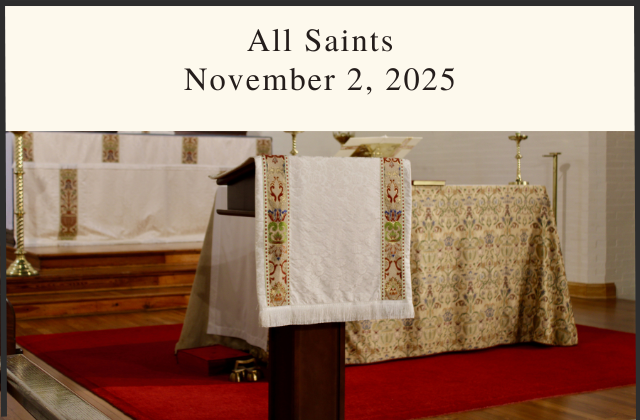
Almighty God, you have knit together your elect in one communion and fellowship in the mystical body of your Son Christ our Lord: Give us grace so to follow your blessed saints in all virtuous and godly living, that we may come to those ineffable joys that you have prepared for those who truly love you; through Jesus Christ our Lord, who with you and the Holy Spirit lives and reigns, one God, in glory everlasting. Amen.
Q. What is the communion of saints?
A. The communion of saints is the whole family of God, the living and the dead, those whom we love and those whom we hurt, bound together in Christ by sacrament, prayer, and praise. (An Outline of the Faith commonly called the Catechism, “The Christian Hope,” Book of Common Prayer, page 862)
As the whole family of God, the living and the dead, we can also say that the communion of saints is the whole family of God, past and present. Paul addressed his letter to the “saints who are in Ephesus,” and in today’s reading gives thanks for their “love toward all the saints,” of which he has heard. The saints of God were not just those who lived in the past and were now dead. Nor are the saints today just those who lived in the past and are now dead. So today I address the saints who are at Saint Monica and Saint James. And little more than a year after hearing of your love toward all the saints, I now know of your love toward all the saints. So, happy All Saints’ Sunday Saints of Saint Monica and Saint James.

Vindication and Reconciliation
Vindication and Reconciliation
Vindication was what the widow in last week’s parable was looking for. When we heard her nagging the disrespecting judge last week, “give me justice against my opponent,” the Greek word translated “justice” actually means “vindication” or even “revenge.”
In today’s Gospel reading, which comes right after last week’s reading from Luke’s Gospel, we are in a different court, this time with a member of the Pharisee party and a tax collector. The one and only Temple in Jerusalem was a court, where the one God of Israel dwelt and who judged God’s chosen people on the basis of the covenant God had made with them after liberating the Israelites from slavery in Egypt.
The Temple was the court in which the Jewish people confessed their transgressions and made bloody sacrifices that they hoped would persuade God to “justify” them again. The Pharisee belonged to a party in Judaism that stressed total obedience to the Law of Moses. A tax collector working with the pagan Romans in their imperial system of oppression wouldn’t be considered “just” by human standards.

Mixed Motives
Mixed Motives
One group of Jesus’s parables are almost poetic in their use of vivid agricultural imagery, like mustard seeds and weeds among the wheat. Others are stories of human beings, which are also symbolic, but are also vivid depictions of real people with mixed motives in real-life dilemmas. Luke excels in the latter, including today’s parable, which he said was about praying, though the two characters in today’s story don’t actually do any praying.
It doesn’t help that translators too often water down the original Greek. For instance, it’s not so much “justice” that the widow keeps demanding from the judge. It’s more like “vindication,” or even “revenge.” And while widows could often find themselves cut off from family support, there are many examples of Jewish marriage contracts making provision in the case of widowhood that have been found. And Jesus tells us that this widow “kept coming” to the judge, a luxury of time that a poor woman working on her own for her survival wouldn’t have. And as the lawyers among us might have noticed, the widow is getting a lot of ex parte time with the judge, in which the other unnamed party in this lawsuit doesn’t have the chance to respond.
And the judge isn’t afraid of being worn out, as the NRSV weakly puts it. The Greek is literally, “give me a black eye.” We use that as an idiom for harming someone’s reputation. But it might well have been understood literally, that the widow would slap the judge around, or perhaps pay someone else to do it for her. None of this is meant to put a white hat on the judge, who says he has no “respect” whatsoever for God or for his fellow human beings. And for all we know in this alternate universe that Jesus has placed us in, the widow’s opponent has it coming. And in his quest for what he sees as “justice,” the widow’s opponent, being only human, probably has mixed motives like the widow and the judge.

Wedding Homily
You’re not here for the sermon. You are here for Richard and Elizabeth, to do all in your power to uphold them in their marriage. Richard and Elizabeth are here, in this holy and sacred space dedicated to God, because they recognize that the source of their love, of all our loves, is the one and only God whose love “is strong as death, passion fierce as the grave. Its flashes are flashes of fire, a raging flame. Many waters cannot quench love, neither can floods drown it. If one offered for love all the wealth of his house, it would be utterly scorned.”
That love is God’s greatest gift to those whom God made in God’s image: “And now faith, hope, and love remain, these three, and the greatest of these is love.”
There are many other things that often seem to be valued more highly in this world, but they all seem to boil down to power. There is the power to use words to one’s advantage. That’s what Paul is referring to at the beginning of the 13th chapter of his Letter to Church in Corinth when he talks about prophecy and knowledge without love. The blessings that Jesus says his disciples already have are the opposite of power: the power to buy whatever or whoever you want, the power to make others mourn, the power to shut others up, the power that is unbound by any responsibility to others, the power to punish others, the power to impose your will on others.

Strange Profit
Strange Profit
It feels like it’s been an entire liturgical season of Strange Stories by Jesus Christ, with Luke as the ghost writer, the more proper name of the strange stories being parables. So, one more time for those who’ve heard this already: According to the British biblical scholar C.H. Dodd, a parable is, “a metaphor or simile drawn from nature or common life, arresting the hearer by its vividness or strangeness, and leaving the mind in sufficient doubt about its precise application to tease it into active thought.” Jesus’ metaphors today might feel like we’re being set up to fail, and in the story of slaves and masters, downright offensive. Keep in mind, first, that Jesus is speaking to his apostles as one group. Second, slavery was not a metaphor in Jesus’s time, it was a fact of life that he and his disciples would have been all too aware of, and one they couldn’t ignore.
So, when Jesus says, “If you had faith the size of a mustard seed, you could say to this mulberry tree, ‘Be uprooted and planted in the sea,’ and it would obey you,” I need to clarify what is meant by “if” and “you.” Greek has root words whose prefixes and/or suffixes tell you, in this instance, whether it’s the singular “you,” or the plural “you.” English doesn’t, which is why it’s not always clear whether it’s you or y’all, or as they say in the Diocese of Alabama, y’all or all y’all. And the “if” here is not conditional, as in “if I were you,” but a statement of fact, as in, “if you have the right.” So, Jesus is telling us that all y’all, as one, already have such faith that when you speak and act as one, in one faith, you can do amazing things together.
Of course, that means we can’t do these things on our own, without God. “All things come of thee, O Lord, and of thine own have we given thee.”* If we can revive that sense of total dependence on our Creator, that might give us a way to see ourselves in Jesus’s parable of the slave and master. It is extremely unlikely that any of Jesus’s apostles or disciples would have had the means to purchase a slave. They were more likely to have potentially been in the position of being taken into slavery for being unable to pay Roman taxes, having to sell themselves into slavery for failure to pay debts, or being so desperately poor that they had no other way to live. They may well have seen it happen to their neighbors.

Handing Each Other Along
Handing Each Other Along
Today’s parable – not allegory – is not about “Hell.” Notice that Jesus actually calls it “Hades,” as in the underworld kingdom of the Greek god of death. And while in his telling the rich man goes straight from his underground burial to the underworld of the dead, we can safely assume that the Son of God knows that there isn’t some underground place where the shades (not so much souls) of the dead go. So, while Jesus used the images that the people of his time imagined, he is not giving us a photographic description of at least one part of the afterlife.
Neither does Jesus specify how much we should give to the poor. The Law of Moses, and the prophets – Amos among them – was clear about the obligations of the wealthy to help the poor. As Abraham said of the rich man’s brothers, “They have Moses and the prophets. They must listen to them,” as the rich man himself could have done.
But all of us are at risk of building walls of indifference to the poor that we might be tempted not to see. The rich man’s “gate” was just part of a wall that allowed him to pretend that he didn’t know about Lazarus who would have been laid outside his gate, because in a subsistence economy, he would have been the obligatory safety net. But it turns out that the rich man does know Lazarus because he recognizes him in Hades.
BFFs
BFFs
— And I your Lord and Savior tell you, children of the light: Use your money, tainted as it is, to help your eternal friends, so that when your tainted money is gone, they will welcome you into homes where the light never goes out. (Luke 16:9)
How’s that for a Stewardship statement? Do we really know where all our money has come from, or where it all goes? And can we decide not to take any tainted money? No, no, and no. The “dishonest wealth” you heard in the Gospel reading could also be translated “unjust wealth,” or “tainted money,” perhaps something we “children of light” can relate to more easily than dishonest wealth. But, even if we are all implicated in “tainted money,” we can decide what kind of friends to make with our tainted money? That is the Gospel, the Good News that Jesus gives us today. The very strange story he tells today is one with which his disciples could easily identify. And with a little imagination, so can we.
“There was a rich man who had a manager,” or “steward.” A steward was charged with managing the property, in this case, for an absent landowner. He would rent parcels of the land to sharecroppers, then take a percentage of their crops as income for his master, and a commission for himself. With the rich man absent, the steward had a great deal of power. But he didn't have security, because the land wasn't his. Managers in this position were caught between rich landlords who wanted more profits for themselves, and laborers who wanted more wages for themselves.

Celebrating the Cross
Celebrating the Cross
It was the Roman Emperor Constantine, first to legalize Christianity, who ordered the erection of a complex of buildings in Jerusalem “on a scale of imperial magnificence,” to set forth as “an object of attraction and veneration to all, the blessed place of our Savior’s resurrection.” He entrusted this project to his mother, Empress Helena. When she arrived at Jerusalem, she discovered that Calvary Hill, which had stood outside the city walls in Jesus’s time, was now inside the walls of a city which the Romans had built on top of the old city which they had destroyed.
Calvary Hill itself was buried under tons of fill. It took years of excavation to find it, the nearby tomb, or sepulchere, where Jesus had been buried — and from which he rose — then finally a relic believed to be the true cross.
Constantine’s shrine included two principal buildings: a large basilica, used for the Liturgy of the Word, and a circular church, known as “The Resurrection”—its altar placed on the site of the tomb — which was used for the Liturgy of the Table, and for the singing of the Daily Office. In the courtyard between the two buildings, the exposed top of Calvary Hill was visible. So, as the faithful passed from Word to Sacrament, they would see where Christ was crucified. And it was there that the solemn veneration of the Cross took place on Good Friday.